#You'll Be in Great Company
From Local Businesses to National Brands. Across IT, Print, LED, AV and Commercial Solar solutions Australia-wide.




Commercial Solar Designed Around Your Business
Commercial solar designed, installed and supported Australia-wide.
Whether you’re looking to reduce electricity costs, improve energy efficiency or take greater control of your business electricity bill, the right commercial solar system starts with understanding how your site actually uses power.
At Sharp EIT Solutions, every commercial solar power system is designed around your site, energy usage, operating hours and long-term business goals. We also factor in available government incentives so you can understand your real net cost upfront.
Our Green Energy division is led by Neil Armstrong, General Manager of Green Energy, who brings practical commercial solar experience to every stage of the process — from system design and financial modelling through to installation and long-term performance support.
You get clear advice, honest numbers and a team that remains accountable well after your commercial solar installation is complete.
Commercial Solar Projects Across Australia
#Trusted by the hospitality industrythe transport industrythe logistics industrythe manufacturing industrythe construction industrythe wholesale industryand the retail industry
Sharp EIT has delivered commercial solar projects across a range of industries, including manufacturing, sport, education, hospitality, agriculture, retail and commercial property. Explore recent projects and see how different businesses are using solar to reduce operating costs.

Commercial Solar PanelsCommercial Solar
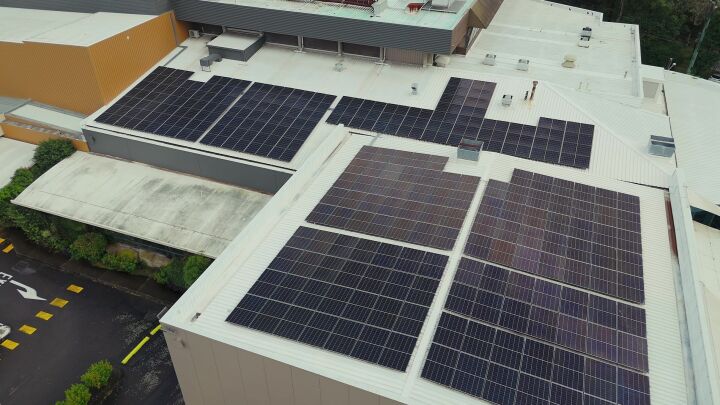
474kW Commercial Solar System – Dincel Structural Walling
Commercial rooftop solar system designed to reduce energy costs with no disruption to operations. Sharp EIT Solutions delivered this 474kW system for Dincel Structural Walling, helping the manufacturer improve energy efficiency across its facility.
HospitalityCommercial Solar PanelsCommercial Solar
100kW Commercial Solar System – North Ryde RSL
Commercial rooftop solar system designed to reduce energy costs and support sustainability goals. Sharp EIT Solutions delivered this 100kW system at North Ryde RSL, helping the club lower its operating costs and improve daytime energy use.
CorporateCommercial SolarCommercial Solar Panels
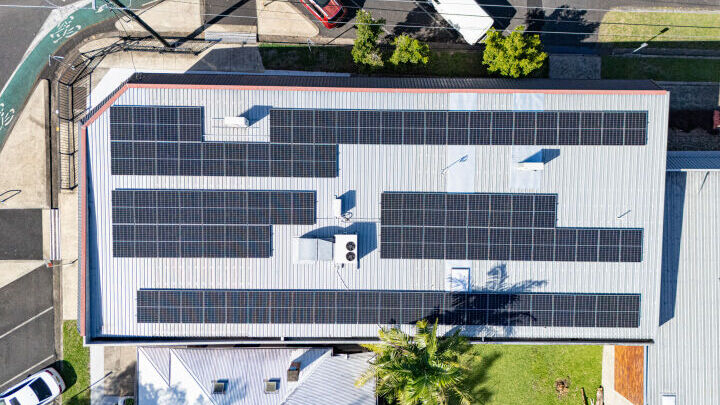
39.6kW Commercial Solar System – Northern Rivers Business Centre
A tailored rooftop solar system designed to reduce operating costs and improve long-term energy independence. Estimated savings of $9,732 per year with an estimated 2–3 year payback.
Commercial Solar System Types
#Commercial Solar Solutions for Every Business
From rooftop commercial solar panels to car park canopies, agri-solar and ground mount systems — we'll find the right fit for your site.

Commercial Rooftop Solar
Turn unused roof space into a commercial solar power system that helps reduce daytime electricity costs, improve energy efficiency and support long-term savings for your business.

Solar Car Park Canopies
Generate clean energy while creating shaded, weather-protected parking for staff, customers and visitors. Solar car park canopies help maximise available space and reduce grid electricity use.

Agri-Solar Systems
Agri-solar systems combine solar generation with productive land use, helping farms and agricultural sites reduce energy costs while continuing operations beneath elevated solar arrays.

Ground-Mount Solar Systems
Ground-mount commercial solar systems are ideal for large sites, open land, industrial facilities and businesses with limited roof space. Deliver large-scale generation and long-term energy savings.

Commercial Battery Storage
Commercial battery storage helps businesses store excess solar energy, reduce peak demand charges, improve backup power resilience and get more value from their solar investment.

EV Charging for Business
Install commercial EV charging stations for staff, fleet or customer vehicles, powered by your solar system or site electricity. Support future transport needs while improving your business facilities.

Commercial Solar Finance Options
Whether you prefer to purchase your system upfront (Capex) or install commercial solar with $0 upfront finance, we'll find the right fit for your site and cashflow — with clear savings modelling so you can see the financial impact before you decide.

Why Sharp EIT for Commercial Solar?
We combine commercial solar expertise with national business technology experience, giving you a team that understands sites, operating costs, infrastructure and long-term support — not just panel installation.
Every recommendation is based on your actual energy usage, site conditions and business goals, so you can make a clear decision before committing.
- Australian-owned business with Australia-wide capability
- Commercial solar solutions designed for business sites, not residential installs
- Site-specific energy, tariff and usage assessment before we propose anything
- Transparent modelling across savings, incentives, finance and payback
- Installation planning designed to minimise disruption to your operations
- Ongoing monitoring and support after the system is installed
How it works
#Our Commercial Solar Quote & Installation Process
Our process is designed to minimise disruption to your business and help your commercial solar system perform long-term, not just on day one.
1. Site and energy assessment
We review your energy bills, usage profile, operating hours, tariffs, roof, land or car park availability, site constraints and business goals.
2. System design and savings modelling
We design a commercial solar system matched to your load profile, available space and future energy needs, then model expected generation, savings and payback.
3. Finance and incentive review
We factor in available government incentives and finance options, including $0 upfront options where eligible, so you can understand the real upfront cost, repayment options and projected return.
4. Approvals, compliance and grid connection
We manage the required approvals, compliance checks and grid connection requirements before installation begins.
5. Installation with minimal disruption
Our team schedules the works around your site operations, with staged installation where needed to help keep your business running.
6. Commissioning, handover and support
We test system performance, provide handover documentation, and offer monitoring and ongoing support to help protect long-term performance.
#How Much Could Commercial Solar Save Your Business?
Request an assessment and we'll share projected savings, options suited to your site, and clear next steps. No obligation, no pressure.
#Frequently Asked Questions About Commercial Solar
Commercial solar is solar power for commercial buildings and operations typically a commercial solar power system using commercial solar panels (solar PV) installed on rooftops, car parks, or as ground-mount. It reduces grid electricity use and can improve long-term energy costs and resilience. You can compare system types here.
Commercial solar power is electricity generated from solar PV panels installed on a business or commercial property — as opposed to a residential home. A commercial solar power system typically ranges from 20kW for smaller businesses to several megawatts for industrial facilities, and is designed to offset a significant portion of the business's grid electricity consumption during daylight hours.
Commercial solar electric systems are solar photovoltaic (PV) systems designed to generate electricity for commercial and industrial use. The term is used interchangeably with 'commercial solar systems' and 'commercial solar power systems'. They typically include solar panels, inverters, mounting structures, metering, and grid connection infrastructure — all designed and sized for a business's specific energy requirements.
The terms are often used interchangeably. 'Industrial solar' typically refers to larger-scale systems — generally 250kW and above — installed for manufacturing, processing, or heavy industrial operations with high and continuous electricity demand. 'Commercial solar' covers the broader range from small businesses (20kW) through to large commercial and industrial installations (1MW+). Sharp EIT designs and installs both commercial and industrial solar systems across Australia.
Most businesses choose solar power for business to lower operating costs and reduce exposure to rising energy prices. A well-designed commercial solar power system can also improve energy independence and support sustainability targets, without changing day-to-day operations.
Savings depend on your energy use, tariff, and how much solar you can use onsite. Many businesses see meaningful reductions in electricity costs, especially when the system is sized for daytime loads and paired with options like battery storage (where it stacks up financially). You can see typical pricing factors on our costs page.
Sometimes, especially if your load profile matches solar production (daytime use) and the site can fit a larger system. Many businesses use commercial solar to cover a significant portion of demand and keep the grid for nights/peaks, and battery storage can further reduce grid reliance. See common system sizes here.
Sizing is based on your interval data (when you use power), available area (roof, car park or land), and network/approval constraints.
Commercial systems often start around 20kW and scale to 100kW and 250kW+ depending on the site, with industrial solar systems commonly sitting at the higher end. For large-scale ground mount, we also engineer solar farms from 500kW to 5MW. See common system sizes here.
Yes, we deliver commercial solar installation for businesses across Australia, from rooftop to car park canopies and larger site-based projects. You can view options by system type and system size.
We install commercial solar across multiple formats: rooftop, solar car park canopies, walkways, ground-mount and larger site-based systems—including Agricultural solar systems (AgriSolar) where it suits the operation and approvals. See system types here.
Yes. Battery storage can help capture excess solar generation, manage peak demand and improve self-consumption—particularly for businesses with evening loads or demand charges.
Yes. Many commercial solar installations are designed so battery storage can be added later. The key is choosing compatible inverters/switchboard design and allowing space for future expansion.
Yes. EV charging can be integrated with commercial solar power so charging aligns with solar production. This can work for staff parking, customer charging or fleet depots, depending on site capacity and electrical design.
Yes. We offer monitoring options for commercial solar systems so you can track generation, consumption, and system performance in real time. Monitoring allows early identification of faults or performance drops — protecting your investment and ensuring your system continues delivering the savings it was designed for. Ask about monitoring options when requesting your assessment.
Most rooftop commercial solar installations take 1–5 days on site. Approvals and grid connection add 2–8 weeks before installation begins. Car park canopies and ground-mount projects have longer installation windows — we'll confirm your specific timeline during feasibility.
Most commercial solar systems include manufacturer warranties on panels and inverters, plus a workmanship warranty on the installation. Exact coverage depends on the system design and the components selected. We’ll confirm the warranty terms in writing as part of your proposal so you know what’s covered and for how long.